


Tip on how to manage a Frozen Shoulder
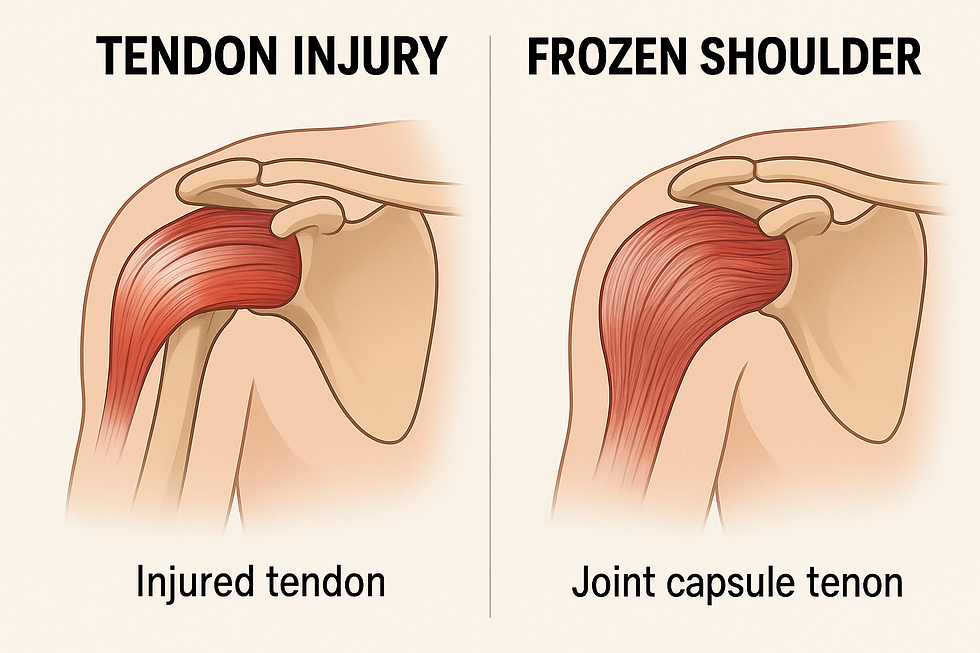
Frozen shoulder (also called adhesive capsulitis) is a condition where the shoulder becomes stiff, painful, and limited in movement. It happens when the capsule of connective tissue around the shoulder joint thickens and tightens, restricting movement.
🔹 Relation to tendon injury:
A frozen shoulder is not directly a tendon injury, but it can sometimes develop after a tendon injury.
For example, if someone has a rotator cuff tear, tendonitis, or a shoulder injury, they may avoid moving the arm due to pain.
This lack of movement can cause the joint capsule to stiffen and eventually lead to frozen shoulder.
Inflammation in or around the tendons (like rotator cuff tendinopathy) may also trigger irritation in the joint capsule, contributing to adhesive capsulitis.
🔹 Key differences:
Tendon injury = affects tendons (fibers attaching muscle to bone) → usually localized pain, especially with certain movements.
Frozen shoulder = affects the joint capsule → leads to global stiffness and loss of motion in almost all directions.
🔹 Risk factors:
Previous shoulder injury or surgery (including tendon injury)
Prolonged immobilization (keeping the arm still for too long)
Diabetes and thyroid conditions
Middle age (40–60 years), more common in women
👉 In short: frozen shoulder is not the same as a tendon injury, but a tendon injury can contribute to or trigger frozen shoulder if it leads to restricted shoulder movement and joint capsule tightening.
Treatment for frozen shoulder (adhesive capsulitis) usually combines pain control and therapies that improve mobility. Since it can last many months (sometimes 1–3 years), early management helps reduce severity.
🔹 Non-surgical Treatments
1. Pain Management
• NSAIDs (ibuprofen, naproxen) to reduce pain and inflammation.
• Corticosteroid injections into the joint capsule for temporary relief.
• Heat or cold packs for comfort.
2. Physical Therapy (Mainstay of treatment)
• Gentle stretching exercises: pendulum swings, towel stretches, finger walk up the wall.
• Gradual range-of-motion exercises supervised by a physiotherapist.
• Consistency is key—regular daily stretching helps loosen the capsule.
3. Activity Modification
• Avoid total immobilization; keep the joint moving within pain limits.
• Support the arm during sleep to prevent discomfort.
🔹 Advanced Options (if conservative treatment fails)
• Hydrodilatation: injection of sterile fluid into the joint capsule to stretch it.
• Manipulation under anesthesia (MUA): shoulder is forcefully moved while you’re asleep to break adhesions.
• Arthroscopic capsular release: minimally invasive surgery where tight parts of the capsule are cut to restore motion.
🔹 Self-Care & Recovery
• Recovery is gradual, often taking 12–24 months.
• Gentle, persistent movement is better than aggressive stretching (which can worsen pain).
• Patients with underlying conditions (like diabetes or thyroid issues) may need closer management, as frozen shoulder is more persistent in these cases.
👉 Best results usually come from a combination of medication, physiotherapy, and lifestyle adjustments—surgery is rare and used only if conservative therapy fails.
Exercise
How to Do It
Reps / Time
1. Pendulum Swing
Lean forward slightly, let the affected arm hang down. Gently swing in small circles (clockwise and counterclockwise).
1–2 minutes each direction
2. Towel Stretch
Hold a towel behind your back with one hand overhead and the other behind your waist. Use the top arm to gently pull the lower arm upward.
10–15 reps
3. Finger Walk (Wall Climb)
Face a wall, walk your fingers up as high as possible without pain, then slowly walk them back down. Keep elbow slightly bent.
10–15 reps
4. Cross-Body Stretch
Use your good arm to pull the affected arm across your chest at shoulder level. Hold gently.
Hold 15–30 sec × 3–5
5. Outward Rotation (with Elastic Band or Towel)
Keep elbows bent at 90°, hold band/towel in front of you. Move the affected arm outward slowly.
10–15 reps
6. Inward Rotation (with Elastic Band or Towel)
Same start position. Move affected arm inward across belly.
10–15 reps
✅ Tips for Success
• Warm up first with a warm shower or heating pad.
• Move within comfort—mild stretching pain is okay, sharp pain is not.
• Consistency is more important than intensity.
• Expect slow but steady improvement over months.
Here’s a simple daily home exercise chart for frozen shoulder that you (or a patient) can follow. These are gentle, progressive movements—avoid forcing the shoulder through sharp pain. Do them once or twice daily unless otherwise advised by a healthcare provider.
⸻
🏠 Frozen Shoulder Daily Exercise Chart



Comments